



Top 10 Places to Visit in the Sandoy Region, Faroe Islands
Link Copied!

We know how overwhelming it can be to plan a trip, and we hope that we, with this top 10 list, can help you a little with your planning.
The Faroe Islands are truly untouched and unspoiled, but the Sandoy region is on a whole different level! The Sandoy region is known for its agricultural background, with greenhouses, potato fields, and an overall farming community. They even have a food and ‘soil’ culture school with short courses focusing on food, agriculture, sustainability, etc.
The Islands are relatively flat compared to, for example, the northern islands, and hiking is therefore ideal for the less experienced. Hiking in the mountains here is extraordinary, especially because of the rich birdlife. The reason for the high number and diversity of birds is that there are no rats on the islands! And on Skúvoy and Stóra Dímun, they don’t even have cats, so birds in this region have a very limited number of predators.
The region has much potential for outdoor activities such as cycling, hiking, surfing, kayaking, birdwatching and even open-water swimming, if you dare to swim in the 8 degrees Celsius ocean. Although it is tough to choose a top 10 list, since the islands have so much to offer, we’ll try our best to pick a few of the best locations. Enough talking, let's get on to the list:
10.

photo: Derek Malou – @d_malou
THE VILLAGE OF DALUR
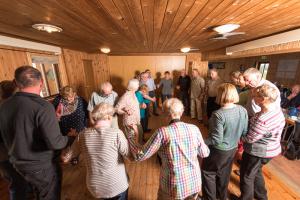
Dalur is a small, isolated village in the east of Sandoy with only 35 people living there. The people of Dalur (also known as Dalbingar) are known for being good ballad chanters for the Faroese chain dance. The Faroese chain dance association Stígum Fast is based in Dalur, and Dalur also has a communal house, Eiriksgarður, that is well suited for events, Faroese chain dance, accommodation, e.g., camp school, and more.
You can read more about the village and viewpoints in the village here
9.

Photo: Kirstin Vang
FAGRIDALUR
Does this need any explanation as to why you should visit this magnificent valley on Skúvoy? Well, the name of this valley translates to ‘The beautiful valley’, and we can tell you, it lives up to its name.
There is only one rock in this valley; it's called Tróndarsteinur. According to the Faroese Saga, legend says that Tróndur í Gøtu hid behind this rock when Sigmundur Brestisson was about to strike him with the sword. The sword's mark is visible on the rock. Sigmundur and his associates threw themselves off the cliff and swam to Sandvík from here.
The valley is also connected to the sorrowful story about Rannvá. Legends say that Rannvá was a banished farmer’s daughter sent to exile in this valley after she got pregnant out of wedlock. Since she and her daughter were isolated in this valley, she was one of only two survivors in Skúvoy from the Black Death Plague. The ruins of the house can be seen in the valley.
The owners of the outfield charge 50 kr. to hike on your own, but we recommend a guided tour so you can hear all the stories connected to this magnificent place. Contact us at info@visitsandoy.fo, and we’ll provide you with a local guide.
8.

Photo: Kirstin Vang
CAFÉIN Á MØLINI
The name ‘Caféin á Mølini’ translates to ‘The café by the pebble-covered beach’. Yes, we do have a specific word for pebble-covered beaches, and it is as simple as ‘Møl’.
The café is part of a four-generation commercial enterprise that has been in operation since 1889 and has changed throughout the years from a shop to a post office, selling spirits, and storing beer for Føroya Bjór. The founder of the enterprise was the great-grandfather of the current owner, Birita Dalsgaard. The café is, therefore, an authentic experience of the commercial history of Skálavík, decorated with artefacts from past activities of the house.
They will also open a guesthouse in the summer of 2021, starting with 10 rooms, each with a bathroom and a nice ocean view! More information about this will come.
You can read about opening hours on their personal Facebook page here
7.

Photo: Kirstin Vang
KAYAKING ON SANDSVATN
Explore the untouched nature of the Faroe Islands as you glide through the beautiful lake Sandsvatn. This much-appreciated lake in Sandur will give you a hands-on experience of the pristine natural wonders.
Lake Sandsvatn is situated behind the local beach. Sandsvatn is a long and shallow lake rich in trout, and every spring it is the last resting place for whooper swans on their way to Iceland.
There are small valleys around you, so in the interior, Sandoy gives a softer and more rounded impression than most other islands. Sandoy is the most fertile island in the Faroe Islands so that you will enjoy the rich bird life and flora around the lake.
6.

Photo: Kirstin Vang
SANDUR VILLAGE MUSEUM
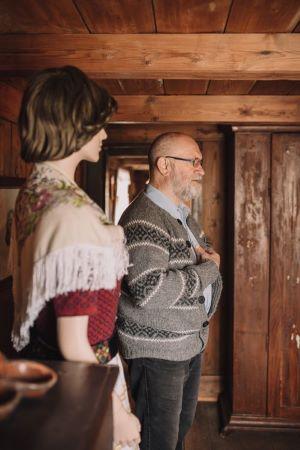
Sandur Village Museum is based in the ancient settlement of Í Koytu, whose cadastres tell us people lived there in 1584.
The local village museum is the homestead in Norðara Koyta, built by Hanus Jóhannesarson, later known as Hanus í Koytu. He settled there in 1812. The word koyta means “hollow.”
In 1988, the Sandur Village Museum bought the house and began restoring it. This gives us a chance to see what an ordinary home looked like and how people used to live.
You can read more about prices and opening hours here
5.

Photo: Kirstin Vang
THE TURF HOUSE BY THE LAKE
This is probably one of the most photographed houses on Sandoy. This is a tiny summerhouse situated between the villages Skopun and Sandur. You’ll pass it on your way to Sandur from the ferry.
The house is unique, constructed with tiny stones and a turf roof by a small lake called Norðara Helsavatn. It’s easily accessible from the main road to snap a beautiful picture! (but please be careful not to interrupt traffic)
4.

Photo: Kirstin Vang
THE GREENHOUSE VELTAN
Veltan is a community for people interested in greens and cultivation. Some members produce for sales, and others for their own kitchens. Those who want to sell can use the brand Veltan and sell their produce through the community.
The members at Veltan believe that you should be able to eat Faroese greens in the Faroe Islands! Either what you grow yourself, or what you buy from locals.
They grow salad, cabbage, carrots, leeks, roots, potatoes, and peas—some in larger quantities and some as tests. They continuously try to create variation and knowledge about different kinds of crops.
At Veltan, they can provide tours, but it’s always open for guests to have a look.
You can read more about Veltan here
3.

Photo: Kirstin Vang
HEIMABLÍDNI
In the Sandoy region, several locals offer ‘Heimablídni’. Arguably, the best way to really experience any culture is to integrate with the locals. And what better way to do this than over a delicious, traditional meal?
The Faroese phrase “heimablídni” translates directly as “home hospitality”, and all across the region you can enjoy authentic and intimate dining experiences in people’s homes. In addition to being served traditional homemade Faroese food, you will also hear interesting stories that relate to that particular part of the country or village.
These underground restaurants, with rates sometimes as little as DKK 330 (approx. €45) per person, offer you the opportunity to sample new food, often dissimilar to the food usually served in restaurants, in personal environments that give you a proper taste of Faroese culture.
Sometimes a perfect stranger is the best dinner host.
See what the region has to offer regarding Heimablídni here
2.

Photo: Derek Malou – @d_malou
HÚSAVÍK-SKÁLAVÍK VILLAGE PATH
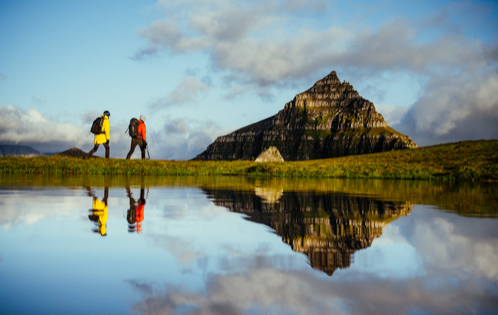
AN EASY, TRANQUIL AND QUIET HIKE. THE VIEW WESTWARD THROUGH THE VALLEY TOWARD THE VILLAGE OF SANDUR IS PARTICULARLY BEAUTIFUL.
It is easy to find the path in Húsavík. Walk up to the highest road on the north side of the village. You will find a gate where the tarmac ends that takes you to the path. The first cairn is not visible from the gate, but as you have ascended a little, you will see it, and from there the clearly visible cairns will lead you on.
Finding the path in Skálavík is more difficult since there is no gate in the village wall that indicates where the path starts. Walk eastward about 350 metres until you come to a sheep pen. Here you will find a gate leading to the path, but the first cairn is not visible.
The path can be taken in either direction, and weather conditions and available transportation determine which direction is taken.
The path is not visible, but large cairns signpost the route most of the hike.
You can book a guided tour by contacting us at info@visitsandoy.fo, and read more about this hike here
1.

THE YARN-BOMBED ROCK
The ‘yarn-bombed rock’ is inspired by a local legend about the ‘Troll Woman’s cave’. Local women have covered a large rock with knitted fabric that they have knitted themselves.
The stone decorations can be seen at Bartalstrøð in the period between mid-May and mid-August.
Our local guides offer guided saga and adventure tours. One of these adventures is the tale about the witch and the huge yarn-bombed rock near Gróthúsvatn. We hear about the witch, follow her footsteps and look for the cave where she lived. Following the footsteps of the witch and back to Sandur takes about 2 hours total. Check out the tour by clicking here